
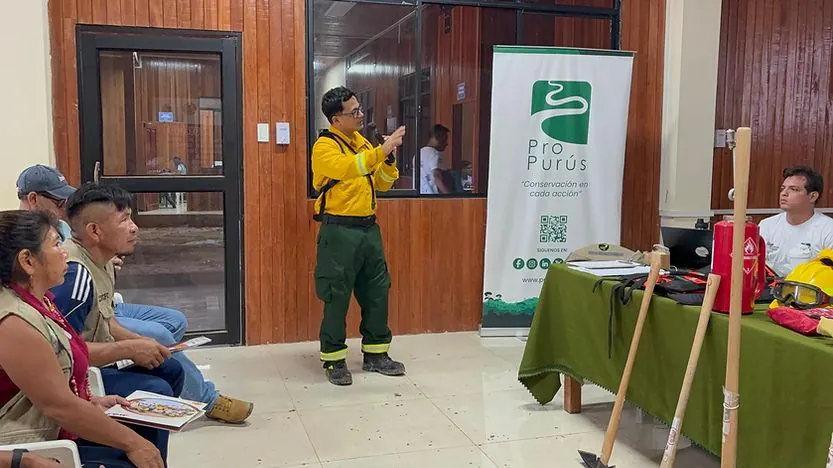
As part of the Training Programme of the Rewild project, the Third Field School (ECA) entitled "Prevention and control of forest fires in communal territories" was successfully held on 10 and 11 September at the District Municipality of Yurúa, with the active participation of community leaders, Community Surveillance Committees (CVC), local authorities and specialists.
Panoramic view of the workshop with participants gathered in the auditorium.
The problem of forest fires in Ucayali
In recent years the Ucayali region has seen an alarming rise in forest and grassland fires, with thousands of hectares affected each year, mainly in communal forest areas and territories of high biodiversity. These events cause serious environmental impacts, including loss of forest cover, harm to wildlife species and carbon emissions that contribute to climate change.
Unlike other parts of Peru where disaster response has greater resources, in Yurúa the institutional capacity to respond to a forest fire is practically non-existent, which reinforces the urgent need to strengthen local communities in prevention, preparedness and emergency control.
Training that is key to prevention
The session began with an entry test to measure participants' prior knowledge of forest fires. The results showed high motivation, with an initial pass rate of 80%.
During the sessions, participants received training on key topics such as:
· Preventive action against forest fires.
· Fire basics and associated risks.
· Correct use of personal protective equipment (PPE).
· Fire-fighting tools and techniques.
The training was led by specialists Marco Antonio Vela Culqui and Kerwin Diego del Águila Ybarra, representatives of the Forest Fires Project of the Regional Forestry and Wildlife Management Office.
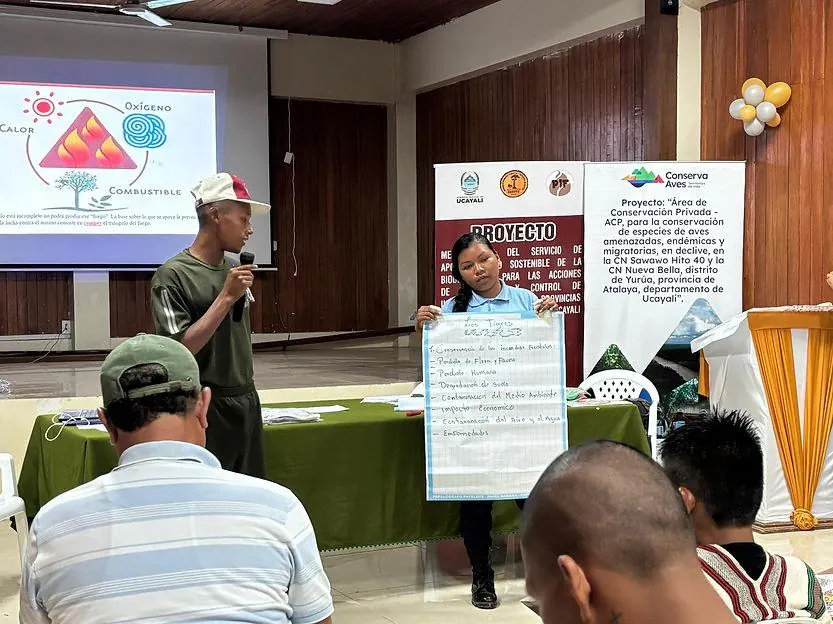
The methodology encouraged active participation: community members worked in groups to identify the causes and consequences of fires and measures to prevent them. Each group then presented its conclusions in plenary, enriching the exchange of local and technical knowledge.
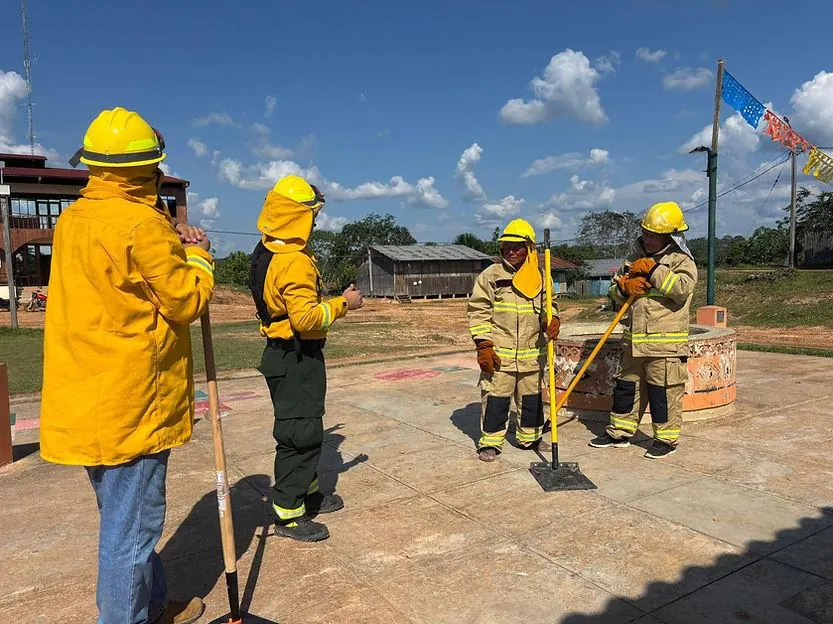
One of the most significant moments was the field practice, where the CVCs of the native communities of Nueva Victoria, El Dorado, Koshireni, Sawawo Hito 40, Oori and Nueva Bella had the chance to handle for the first time the PPE and tools provided for emergencies. These simulations generated great interest and motivation, consolidating practical learning that is now part of their preparedness.
The workshop also included the Civil Defence team of the District Municipality of Yurúa, which reinforced the importance of institutional coordination in tackling forest fires.
At the end of the training, an exit test again showed an 80% success rate in understanding and applying the content, demonstrating a real strengthening of community capacities.
The experience was especially valuable for the Community Surveillance Committees, which now incorporate this knowledge into their daily surveillance work, ensuring better preparedness for fire risks in their territories.
With the presence of specialists, local authorities such as Manuel Arévalo Mogrovejo, mayor of the District Municipality of Yurúa, and Nilder Camaytia Ruíz, records secretary of ACONADIYSH, together with community leaders and residents, this Third Field School reaffirms the collective commitment to protecting Amazonian biodiversity and the safety of Indigenous communities.
This important training effort is possible thanks to the financial support of Re:wild and takes place under the project "Strengthening Indigenous Community Surveillance in Purús – Manu Conservation Mosaic", implemented by the Asociación Fronteras Amazónicas – AFRONTA, reaffirming the joint commitment of partner organizations and local communities to protecting biodiversity and strengthening community capacities to prevent and tackle forest fires in their territories.