
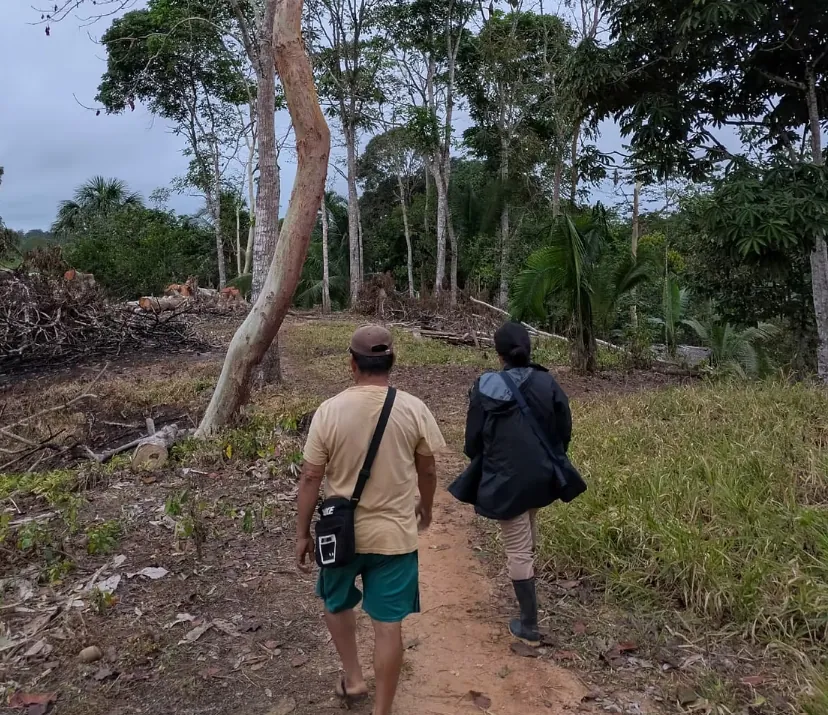
One morning he could walk 30 minutes from his maloca to the hunting grounds; 30 years later a lattice of cattle ranching, coca crops and maceration pits has made the forest unrecognizable. Mateo, the community's chief, whose name we withhold for his protection, carries on his shoulders the hopes of 200 residents of the native community of Unipacuyacu, of the Kakataibo people, which is seeking title to its communal territory.
The Asociación Fronteras Amazónicas – AFRONTA and ORAU, through the report Situation of Indigenous Defenders 2024, warned that this community in the province of Puerto Inca, Huánuco, was recognized in 2005 and has still not been able to complete the titling process. According to the study, "part of this delay is linked to the fact that various State bodies have been granting permits and rights over these territories through different mechanisms, such as forestry concessions, mining concessions, authorizations to use different resources, land-use change permits and the formalization of rural properties for monoculture plantations".
"We are hemmed in," says the APU (community chief). The territory that once held hundreds of hectares of virgin forest is now land held by cattle ranchers, farmers and drug traffickers. "Everyone owns our land except us," reflects Mateo. Of 22,946 hectares, community members currently control only 4, according to the Legal Defence Institute.
It is in the hands of the Regional Government of Huánuco, led by Antonio Pulgar Lucas, to grant Unipacuyacu its title. The demarcation process was due to begin on 26 June, but this did not happen because the Specialized Technical Team (ETE) had not been set up, as the Federation of Kakataibo Communities warned.
The ORAU and AFRONTA study explains that these territorial conflicts have led to an increase in threats against Indigenous defenders. In May 2022, Marcelino Tangoa learned that a price had been put on his life; two hours from the nearest police station in Puerto Inca, he left the community and went into hiding for two months.
For the Regional Organization of AIDESEP in Ucayali, the decision to grant title to Indigenous territory responds to the interests of a range of actors whom communities confront through representatives who become visible as Indigenous defenders.
The Indigenous organization warns that this affects more than 50% of Indigenous territory in the Ucayali region, with direct impacts on the safety of those who defend their ancestral land.
Ucayali, Loreto (Padre Márquez and Contamana) and Puerto Inca (Huánuco) form the geographical focus of the report. It documents cases where legally titled communal territories overlap with permanent production forests (BPP), mining concessions and rural properties granted to third parties, often without prior consultation or the communities' knowledge.
The report found that 110 native communities face reported territorial problems. This figure does not rule out other communities experiencing unreported conflicts, some arising from land rented out by individual community members, which are not reported to Indigenous organizations.
Of the 605 communities in the study area, 454 hold title (they have been granted an area of land), and of these, 121 overlap with permanent production forests — that is, a little over 26% of native communities. This explains the delay in completing the legal formalization of native communities, which leaves Indigenous people in a state of territorial insecurity.
According to the Regional Agriculture Directorate of Ucayali (2024), there are 553 native communities at different stages of formalization. Of these, 124 are titled and georeferenced, while another 192 are titled but not georeferenced. The communal area under dispute or with incomplete proceedings exceeds 2.9 million hectares.
In Loreto, the Ministry of Culture (MINCUL) database records 17 Indigenous settlements in the district of Padre Márquez, of which 12 are recognized and titled native communities. According to the same source, Contamana has 33 recognized Indigenous settlements, of which 22 are recognized as native communities but only 21 hold title deeds.
In Huánuco, specifically in the province of Puerto Inca, MINCUL identifies 15 settlements, all 15 of them recognized but only 10 holding title deeds.
AFRONTA found that the most frequent overlap is with permanent production forests, which occupy more than 40% of Indigenous territory in some districts. On the Pisqui river, native communities live alongside legal and illegal loggers operating under permits granted by the State over communal land.
"Overlapping is not just a legal technicality, it is the origin of the violence our communities suffer. Communities that oppose unauthorized exploitation face threats, harassment and, in extreme cases, the murder of their leaders," says Carla Limas, coordinator of AFRONTA's Amazon Observatory of Environmental Crime.
Limas notes that 57 murders of environmental defenders have been recorded since 2010, most of them in the country's Amazonian regions.
The study points to institutional fragmentation as a key factor. While the Ministry of Agriculture grants rural titles, the Ministry of the Environment regulates forests and protected areas, and the Ministry of Energy and Mines awards concessions without coordinating with regional directorates or with communities.
It also reports that communal titling processes are bureaucratically slower: they take between 5 and 10 years, compared with the 6 to 9 months needed to title an individual property, which favours the advance of private land parcelling.
Indigenous organizations have raised this situation with national and international bodies, demanding a moratorium on the granting of overlapping titles and the creation of a single, interoperable database on Indigenous territories.
For ORAU, until these structural failures are corrected, Indigenous territory will remain a board of overlapping interests, and defenders the expendable pawns of a system that prioritizes exploitation over justice.